
You are missing teeth, or facing a set that is failing. A dentist mentions two paths: teeth in a day, or traditional implants. One promises a new smile by dinner. The other takes months. You just want to know which one fits your mouth.
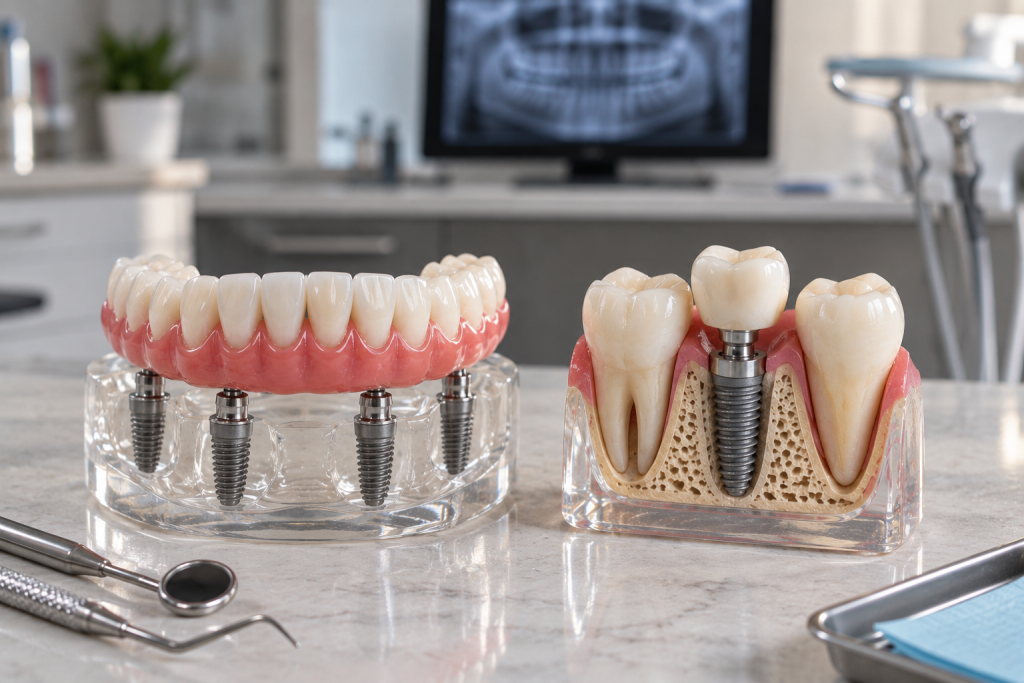
Both use titanium implants placed in your jaw. The difference is timing. Teeth in a day gives you temporary teeth the same day as surgery. Traditional implants let the bone heal for months first, then add the teeth. Teeth in a day suits people with strong bone who want speed. Traditional suits people who need grafting or a very precise single crown.
I am Dr. Philip J. Cimo, DDS, FAGD. I place and restore implants in our own surgical suites at our West Houston practice, so one team handles your whole case. Let me walk you through both, plainly.
What Each Option Suits, in One Look
Teeth in a day works best for people with healthy gums and enough solid bone who want fewer appointments. Traditional implants work best for people who need bone grafting, have a single tooth to replace, or want the most studied timeline. Neither is better across the board. The right pick depends on your bone, your health, and your goals.
- Teeth in a day fits you if you have strong jawbone, healthy gums, and want to avoid months without teeth.
- Traditional implants fit you if you need grafting, have bone loss, or are healing from infection.
- Both use the same titanium implants and the same daily care once healed.
- Both need follow-up visits before the final teeth go on, no matter which start you choose.
- The only way to know your match is a direct implant exam with 3D imaging.
Teeth in a Day, Explained
Teeth in a day means your dentist places the implants and attaches temporary teeth in a single appointment. Dentists also call it immediate load. You walk out with teeth you can smile with that day, though they are temporary. The final, permanent teeth come later, after the bone heals around the implants.
The approach leans on primary stability. That means the implant grips the bone firmly at the moment of placement. When an implant is stable enough, it can hold a temporary tooth right away. Your dentist checks this during surgery and does not load an implant that feels loose.
This path is not a shortcut to the finish line. It is a faster start. You still return over the next few months so your dentist can check healing, adjust the bite, and place the final teeth. What changes is that you are never walking around with visible gaps.
Traditional Implants, Explained
Traditional implants split the work into stages. First your dentist places the titanium implant in the jaw. Then the bone heals around it for three to six months. Once that bond is solid, your dentist adds the abutment and the final crown or bridge. This is the original method, and it has the longest track record.
The healing stage has a name: osseointegration. The bone grows tightly around the implant surface and locks it in place. The classic Branemark protocol called for three months of healing in the lower jaw and six in the upper jaw. Many cases still follow that rhythm today.
During healing, you are not left toothless in most cases. Your dentist can fit a temporary denture or bridge so you eat and speak normally. The teeth simply are not fixed to the implants yet. That fixed final step waits for the bone to catch up.
How Do the Timelines Compare?
Teeth in a day compresses the early phase into one visit, while traditional implants spread it across several months. Both still need three to six months of bone healing before the permanent teeth go on. The real difference is when you first get teeth you can use, not when the whole case finishes.
With teeth in a day, you leave surgery with a temporary set the same day. Over the following months, you return for healing checks and a bite adjustment. The permanent teeth usually go on once the implants have fully integrated.
With traditional implants, you wait through the healing months before any teeth attach to the implants. The full process often runs six months or more from placement to final crown. Neither path skips healing. One simply hands you teeth to wear while it happens.
Which One Lasts Longer?
Both options can last for many years when the implants integrate well and you keep up your care. Traditional implants carry the longest research record. Immediate load has strong survival data too, though it depends more on getting the candidate selection right. Bone quality and daily hygiene matter more than the start method.
A 2019 systematic review in the Journal of Clinical Medicine looked at 5,349 immediately loaded implants over at least five years. It found a mean survival rate of 97.4 percent. That is a strong number for a same-day approach, though the review stressed it holds under well-defined conditions.
Traditional loading has slightly more predictable long-term outcomes in some studies, especially in weaker bone. The gap is small for the right patient. This is why the exam matters so much. Your dentist matches the method to your bone rather than to a marketing promise.
Long-term implant research backs both paths. Studies tracking implants past ten years report survival above 95 percent in the general population. What drives failure is rarely the start method. It is smoking, uncontrolled diabetes, gum disease, and skipped cleanings. Protect the implant daily and it tends to protect you back.
Who Is a Candidate for Each?
Strong bone and healthy gums point toward teeth in a day. Bone loss, active infection, or a need for grafting point toward the traditional, staged path. Your medical history and smoking status also shape the call. Good primary stability at placement is the foundation that makes a same-day tooth possible.
Teeth in a day suits patients who have enough dense bone to hold an implant firmly on day one, healthy gums, and well-managed health. A 3D scan confirms the bone volume before anyone commits to loading the same day. Smoking and uncontrolled diabetes can raise the risk of early failure with immediate load.
Traditional implants suit patients who need bone grafting, have significant bone loss, or are recovering from infection. A staged timeline gives the bone a safer path to a solid foundation. It also fits a single precise front tooth, where the final crown needs exact shaping. We assess each mouth before we recommend either route.
Teeth in a Day vs Traditional Implants, Side by Side
The table below sums up the practical differences. Use it as a starting point, not a verdict. Your own exam settles which path protects your long-term result.
| Factor | Teeth in a Day | Traditional Implants |
|---|---|---|
| Teeth the same day | Yes, temporary | No, temporary denture optional |
| Surgical visits | Often one | One, sometimes more with grafting |
| Bone healing time | Three to six months | Three to six months |
| Best bone condition | Strong, dense bone | Works with grafting and bone loss |
| Track record | Strong, needs right candidate | Longest research history |
| Time without visible gaps | None | Bridged with a temporary |
What Does Each Option Cost?
Costs vary by how many teeth you replace, your bone condition, and the materials used. Teeth in a day often carries a higher upfront price because it bundles surgery and same-day temporaries into one visit. Traditional implants may cost less at the start but can add fees across extra appointments. Ask what each quote actually includes before you compare numbers.
The useful question is not which sticker price is lower. It is what the fee covers: the implants, the temporaries, the final teeth, and the follow-up care. A low upfront number that leaves out the final crown is not truly lower.
At our Houston practice, we go over the full plan and the full cost before you decide. We accept PPO insurance, and we offer financing through CareCredit and Sunbit. Money should not be the reason you avoid asking questions.
Deciding at Our West Houston Office
The choice between teeth in a day and traditional implants comes down to your bone, your health, and your goals. You cannot settle it from an article. A hands-on exam with 3D imaging shows which path gives you the steadiest long-term result. We keep both the surgery and the final teeth under one roof.
We care for patients across West Houston, including Spring Branch, Memorial City, and the Energy Corridor. For anyone anxious about implant surgery, Our dental office in Houston offer sedation options, including for patients with complex medical histories. We speak English and Spanish, and our two on-site surgical suites mean we handle the surgical part in house. You do not get referred out midway through your own case.
You do not have to choose blind. Bring your questions, your history, and your goals. Call Brittmoore Dental at (713) 464-1887 to book an implant evaluation with Dr. Philip J. Cimo. We will scan your bone, review your options, and give you a plan built around your mouth, not a slogan.