
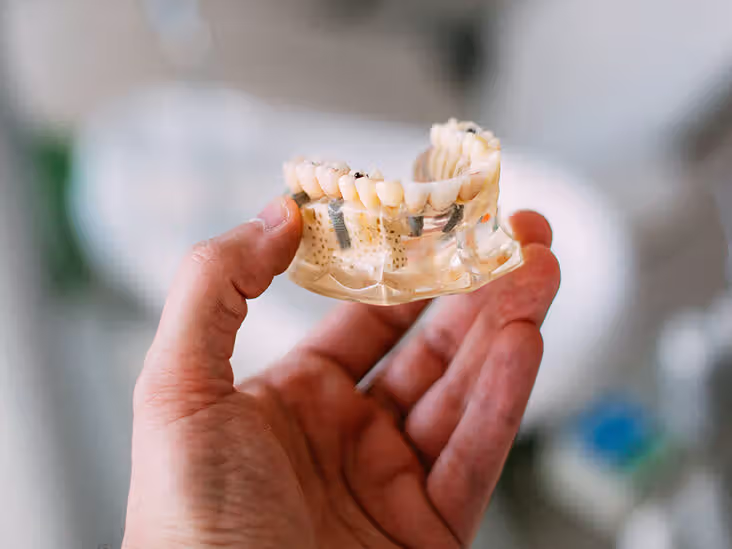
Your physician put you on Fosamax to protect your bones. Now you are missing a tooth, and you want a dental implant. Then you read that bone medication and jaw surgery do not mix, and you stop cold. Is an implant off the table?
For most people on oral bisphosphonates, the answer is no, it is not off the table. Research shows implant success rates in oral bisphosphonate users that match those of people not on the drug. The risk of a jaw complication is real but low. What matters is your exact drug, how long you have taken it, and careful planning.
I am Dr. Philip J. Cimo, DDS, FAGD. Managing dental care for patients on bone medication is one of my main clinical focus areas, and I place and restore implants in our own surgical suites. Let me walk you through what the research actually says.
The short answer before you worry further
Most patients on oral bisphosphonates like Fosamax can get dental implants safely with proper planning. Studies report implant success rates of 95 to 100 percent in these patients, close to the rate for people not on the drug. The jaw complication risk is low for oral users, higher for IV users. Tell your dentist your exact medication and start date so the plan fits you.
- Oral bisphosphonates for osteoporosis carry a low jaw risk, and implant success rates stay high.
- IV bisphosphonates, often used in cancer care, carry a much higher risk and change the plan.
- Time on the drug matters. Risk rises after about four years of oral use.
- Never stop your bone medication on your own. That is a decision for you and your prescribing physician.
- Bring your exact drug name, dose, and start date to your consultation.
What are bisphosphonates, and why do they matter for implants?
Bisphosphonates are bone medications that slow the cells which break down old bone. That is how they guard against fractures. The same action also slows how the jaw heals after surgery, which is why they matter when you plan an implant. The concern is a rare condition called osteonecrosis of the jaw.
Common oral bisphosphonates include alendronate (Fosamax), risedronate (Actonel), and ibandronate (Boniva). These are the pills taken weekly or monthly for osteoporosis. Many patients do not realize their bone pill belongs to this group, so the drug name is the first thing we check.
The IV versions, such as zoledronic acid (Reclast or Zometa), are a different story. A related injected drug, denosumab (Prolia), works through a separate path but raises a similar jaw concern. The route you take the drug changes your risk more than almost anything else, so we start there.
What the research says about implants on Fosamax
The research is reassuring for oral bisphosphonate users. Many studies put implant success rates in these patients between 95 and 100 percent. That is close to the rate for people who never took the drug. In plain terms, the pills do not seem to make implants fail more often. Jaw complications in these studies were rare.
One often-cited study placed 100 implants in 42 patients taking oral bisphosphonates, most of them on Fosamax. It reported a 95 percent success rate, which the authors noted matched the roughly 96 percent rate for patients not on the drug. No signs of jaw necrosis appeared in that group.
Larger reviews back this up. Across studies of hundreds of implants in oral bisphosphonate users, success rates run from 95 to over 99 percent, with very few cases of jaw complications. The picture for IV bisphosphonate users is different and far more cautious, which is why the two are never treated the same.
One caution with the numbers. These studies describe groups, not you. A high group success rate does not mean every patient is a candidate. It means that, for the right patient on an oral drug, an implant is a reasonable and well-studied option. The exam is what tells us whether you are that patient.
How high is the jaw complication risk, really?
For oral bisphosphonate users, the jaw complication risk is low. Published estimates put the risk after a procedure at roughly half a percent for oral users. For IV users, that figure climbs to around 15 percent. Your route and your years on the drug place you on that range, and the exam sorts it out.
The single biggest factor after route is how long you have taken the drug. Guidance from the American Association of Oral and Maxillofacial Surgeons flags oral use beyond about four years as the point where caution rises, especially alongside steroids or other risk factors. Under four years with no other red flags sits in the low-risk zone.
Other things shift the number. Smoking, diabetes, steroid use, and gum disease all raise risk. The good news is that several of these you can work on before surgery. That is a real reason the pre-treatment visit carries so much weight, since it is where we lower the risk we can control.
It also helps to keep the numbers in perspective. Osteonecrosis of the jaw made headlines mostly because of cancer patients on high-dose IV drugs. Your weekly or monthly pill for osteoporosis is a very different situation. Taking the medication is not a reason to avoid the dentist. Avoiding care and letting problems grow is the bigger danger.
Should you stop Fosamax before getting an implant?
Do not stop your bone medication on your own. This is the most important point here. Any decision to pause therapy belongs to your prescribing physician, who weighs your fracture risk against your jaw risk. For many oral bisphosphonate users, stopping is not needed at all.
Stopping is also less powerful than people expect. Oral bisphosphonates bind into your bone and linger there for years, so pausing the pill for a few weeks does not reset your risk. That is why the planning conversation matters more than any short drug holiday.
What helps most is coordination. We talk with your physician when your case calls for it, so your bone health and your dental plan line up. If a procedure is better staged, or an implant is a better path than an extraction, we plan it together rather than in isolation.
There is also a timing point worth knowing. If you have not started a bone drug yet but expect to, finishing needed dental work first is often the safer order. Once you are already on the drug, that window has passed, and we simply plan around where you are now. Either way, you have a path forward.
What safe implant planning looks like
Safe planning starts with your full medication history and a 3D scan of your jaw. We confirm your exact drug, dose, and years of use, then image the bone to plan the implant precisely. From there we manage the surgical site carefully, treat any infection first, and keep the plan conservative where risk is higher.
A CBCT scan shows the bone in three dimensions, so we place the implant where support is strongest and healing is most predictable. For patients on bone medication, that precision lowers surgical trauma, which is exactly what you want when healing is the concern.
We also keep the mouth as healthy as possible around the surgery. Active gum disease or infection raises risk, so we address those first. Where sedation would help an anxious patient sit comfortably, we offer oral conscious sedation. We build every step to protect the result for someone on bone medication.
None of this needs to feel overwhelming. The plan is simply careful, not complicated. You tell us your medication history, we image your jaw, and we match the approach to your risk. For most oral bisphosphonate users, that path leads to a stable implant and a straightforward recovery.
Getting a straight answer at our Houston office
Managing implants for patients on bisphosphonates is one of my core clinical areas, and it is a case many general dentists refer out. We keep it here, in our own surgical suites, with the surgery and the final teeth under one roof. A consultation gives you a full review of your medication, a 3D scan, and a plan in plain language.
We care for patients across the Houston area, and we welcome elderly and medically complex patients. We speak English and Spanish, accept PPO insurance, and offer financing through CareCredit and Sunbit. If your physician or another dentist has told you implants are risky because of your bone medication, bring that conversation to us.
You deserve a straight answer, not a flat no. Call our Houston dentist at Brittmoore Dental at (713) 464-1887 to book an implant consultation with Dr. Philip J. Cimo. Bring your medication list and your questions. We will review your history, scan your jaw, and tell you honestly whether an implant is a safe path for you.